Choking can happen to anyone, at any age, and without warning — during a meal, while playing, or even in the middle of a conversation. Knowing how to respond quickly and correctly could be the difference between life and death. At Coastal First Aid, we follow the latest Australian and New Zealand Committee on Resuscitation (ANZCOR) Guidelines to provide the most up-to-date and effective first aid advice.
You can access the full ANZCOR guideline here: ANZCOR Guideline 4 – Airway here.
The Essential Steps for Managing Choking
If someone is choking, ANZCOR recommends you follow these key steps:
1. Assess the Situation

- Check for danger — ensure it is safe for you to assist.
- Ask the person, “Are you choking?” A person with a mild obstruction may still be able to speak, cough, or breathe.
- Do not intervene if the person is coughing effectively — an effective cough is the body’s most powerful tool for clearing an airway obstruction.
- If the person cannot speak, breathe, or produce an effective cough, treat this as a severe airway obstruction and act immediately.
- Call 000 if the obstruction is not quickly relieved or the person becomes unresponsive.
2. Encourage Coughing (Mild Obstruction)
- If the person has an effective cough, encourage them to keep coughing — this is the safest and most effective way to dislodge the foreign object.
- Stay with the person and continue to monitor them closely.
- If the obstruction is not relieved, call an ambulance.
- Do not intervene with back blows or chest thrusts while the person can still cough effectively.
3. Deliver Back Blows (Severe Obstruction – Conscious Person)
- If the cough becomes ineffective or the person cannot breathe, call 000 immediately and begin back blows.
- Lean the person forward and deliver up to five firm back blows with the heel of your hand, striking between the shoulder blades.
- After each blow, check to see whether the obstruction has cleared — the goal is to relieve the blockage, not necessarily to deliver all five blows.
- For an infant, place them face-down across your lap in a head-downward position before delivering back blows.
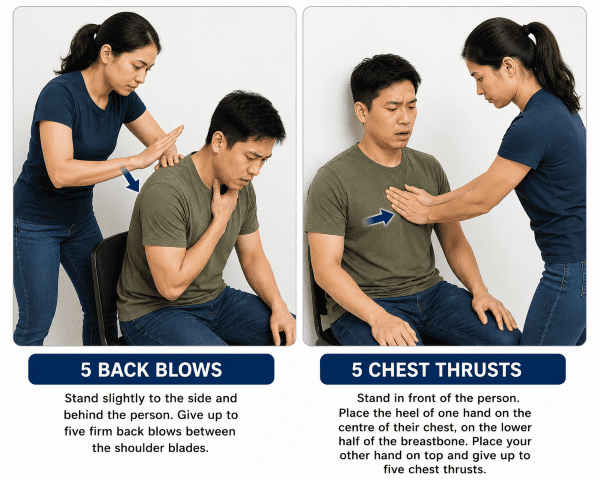
4. Perform Chest Thrusts (If Back Blows Are Unsuccessful)
- If back blows do not clear the obstruction, move on to up to five chest thrusts.
- Use the same hand position as for CPR compressions. Chest thrusts are similar to chest compressions but sharper and delivered at a slower rate.
- Adults and children can be treated in a sitting or standing position. For an infant, turn them onto their back across your thigh with the head lower than the chest.
- Check after each thrust to see if the obstruction has been relieved.
- If the obstruction remains, continue alternating five back blows with five chest thrusts until it clears or the person becomes unresponsive.
5. If the Person Becomes Unresponsive
- If the person loses consciousness, lower them carefully to the ground.
- Call 000 if you have not already done so.
- Begin CPR immediately, following the ANZCOR Basic Life Support Flowchart.
- Do not perform blind finger sweeps in the mouth — only remove a foreign object if you can clearly see it.
6. Know What NOT to Do
- Do not perform abdominal thrusts (the Heimlich Manoeuvre) — ANZCOR does not recommend this technique due to the risk of serious, life-threatening complications.
- Do not slap someone on the back while they are upright and coughing effectively — this may worsen the obstruction.
- Do not perform blind finger sweeps, as these can push the object deeper into the airway.
- Do not give an unconscious person anything by mouth or attempt to induce vomiting.
The Importance of First Aid Training
While this guide provides life-saving knowledge, nothing replaces proper hands-on first aid training like the first aid courses we run in weekly Port Macquarie and Taree. First aid courses provide:

- Confidence to act in emergencies — Choking situations can be terrifying and fast-moving. Training gives you the ability to stay calm, assess severity quickly, and respond with the right technique.
- Practical skills to apply techniques correctly — Back blows and chest thrusts must be performed with the right force and positioning. Practising these skills on a mannequin in a course setting means you’ll be ready when it counts.
- Up-to-date knowledge on best practices — First aid guidelines are updated as new research emerges. A first aid course ensures you are using the safest and most effective techniques — including knowing that abdominal thrusts are no longer recommended in Australia.
Enrol in a First Aid Course Today

At Coastal First Aid, we offer nationally recognised first aid courses that equip you with the skills to manage choking and other medical emergencies. Don’t wait until an emergency happens. Check out our upcoming first aid course dates for Port Macquarie and Taree now and enrol in one of our first aid courses today.